|
|
|
China and other global forces are knocking at the US tool maker's and die casting industry's doors. It is more important now than ever before in the history of our industry to protect our tooling and manufacturing investment.
Since 1983, Badger Metal Tech has been assisting in this task by servicing the die casting industry with its mechanical
MetaLLifeÒ process. It is a well known fact that as a tool loses its hardness and fatigue resistance, heat checking and cracking quickly become a
costly cause of die failure.
MetaLLifeÒ has the ability to close minor heat checks under high compression thereby increasing the material's fatigue resistance and retarding
softening. This helps to retard further cracking and prevent initial cracking on NEW tooling. Also associated with the process, are some side benefits such as: increased lubricity and lube retention to reduce soldering, improved metal flow, and less porosity concentration.
|
Our
MetaLLifeÒ process has been well validated in both numerous lab tests, and ever continuing field tests. For those that have an interest in reading some of these
countless testimonials, click here.
With the 2001 introduction of our thermo-chemical diffusion
ThermaLLifeÒ
process, we can now fully address the other costly phenomena associated with molten aluminum and iron ----
inter-metallic soldering of the aluminum to the tool's surface.
By combining our two processes it is now feasible for Badger to offer a process that not only protects dies from heat checking but also provides the necessary barrier to protect against soldering.
|
 Back to top Back to top
MetaLLifeÒ has always been a line-of-sight process that adds a slight topography to the die.
The
ThermaLLifeÒ
does not add topography, nor is it line of sight limited.
Usually cracking is prevalent in thicker wall areas of castings which are, for the most part, readily accessible. Soldering of the die, on the other hand, can sometimes occur in the inaccessible areas or thin wall sections of the casting. Now, by
combining the two processes, there is a way to protect against both of these areas of failure. |
Coatings are only as good as the substrate that supports them. They usually breakdown because of the substrate failing. In the past it was common to use
MetaLLifeÒ as an effective substrate preparation prior to coating.
Now with
ThermaLLifeÒ
we can offer a diffusion process whereby, in addition to diffusing various beneficial elements into the steel's surface, a compound layer is formed that provides the needed durable barrier to stop the aluminum & iron interaction and covalent bonding.. |
Back to top
We know from
previous testing that
ThermaLLifeÒ
retards soldering by a minimum 4 to 1 factor. We also know that the
MetaLLifeÒ compression benefits are relieved at high sustained temperatures, such as in austenitizing.
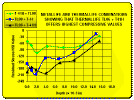
Lambda Research Labs was asked to measure the compressive stress levels of the combination process performed in different sequences to see what effect the operating temperature of the
atmosphere controlled furnace would have on compression.
The testing confirmed that the
highest levels of compression and depth were generated when
MetaLLifeÒ was applied after
ThermaLLifeÒ.
This is the recommended method for new tooling. If a die is heat checked, however, we must first close up as many cracks as possible with
MetaLLifeÒ , then apply
ThermaLLifeÒ.
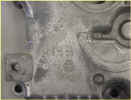
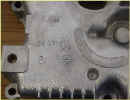
Click here for photos of tooling showing both of these sequences. |
Field testing on numerous die configurations continue, but confirming results are already coming in stating that tooling treated in these manners are lasting longer with little
continuing heat checking and significantly reduced soldering.
With validation by Case Western University, confirmation by Lambda, and numerous actual field tests, it is evident that this is the way to proactively treat both NEW and USED die cast tooling.
If you would like to also benefit from this technology, please get in contact with us by using one of the means given below.
Our next newsletter will give you a glimpse at a new generation Qab diffusion coatings that no longer have substrate failure limitations.
|
Back to top |