You will find these buttons on the top of every page of our web site.
Use them to quickly navigate or return home if you lose your way -
scroll each page as needed.

Stops Thermal Stress Cracking & Pitting Breakout
Often mistaken for heat checking but exhibits itself as breakout.

back to benefits  

MetaLL*ifeÒ protects die casting tools from initial or subsequent thermal stress heat checking by replacing detrimental residual tensile stresses with an encapsulating surface protective layer of compressive stress.  See X-ray diffraction Lambda Curves.  This compression is also present even in cases where the cracks are too large to actually be closed.  By having a compressive force on each end of these cracks, further propagation of the larger cracks is prevented.   Cracks cannot propagate into or through this layer of compressive stress unless the increased effective yield fatigue strength of the steel is exceeded which MetaLL ifeÒ increases by 30-40%.  If Metallife is performed when the tool is NEWer, a cold work plastic flow occurs that closes minor smaller heat checks under compression.

MetaLL*ifeÒ stress protection can be applied to NEW tools to retard the start of heat checking or to USED tooling to safeguard against subsequent heat check propagation. It is possible to close smaller existing cracks in used tooling.  Larger cracks that cannot be closed are still encapsulated at each end of the crack in a compressive stress layer. As most metallurgists know, a crack will not propagate into or through a layer of compression unless the fatigue yield strength is exceeded.  The earlier you catch and attend to heat checking, the more likely it is that we will be able to close the cracks.  See photos below and click here to see comparison photos of cracking in unprotected areas on the same tool.  

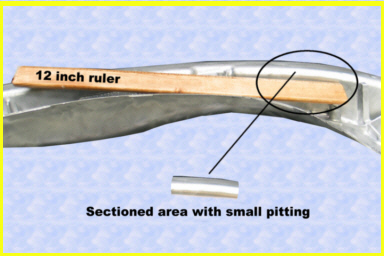
Pitting & Breakout Issues due to Cavitation    Often mistaken for heat checking but exhibits itself as breakout.
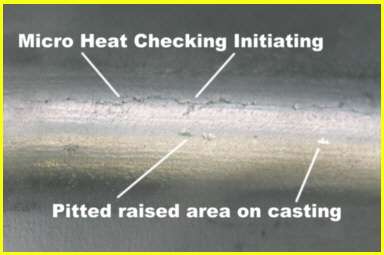
If pitting and/or breakout of the die surface is a problem, this usually exhibits itself in or close to the gate or high velocity areas.  it is very important to address this cavitation effect early before breakout (term for metal falling out of a die due to cavitation) occurs.  MetaLL*ifeÒ addresses this cause of premature failure by reducing the effect of residual trapped gases that pound the die surface into submission.


Pitting of the die causes raised tits or small bumps on casting surface


These small die pits can be corrected with
 MetaLL ifeÒ if addressed at early stages

   
It is best to have us evaluate a casting to advise how successful we may be in smoothing the die's small pitted areas and then to get us the tool as soon as possible.

Back to top


Heat Checking Issues

Click on either the Before or After photo for an enlarged view
   

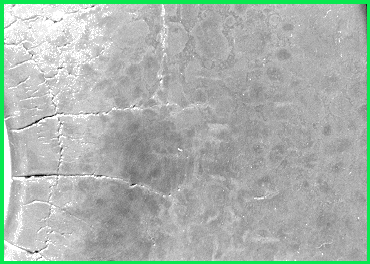
H13 Tooling with cracking on side wall and face

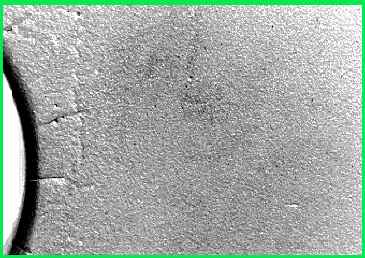
After MetaLL ifeÒ - cracks closed in compression


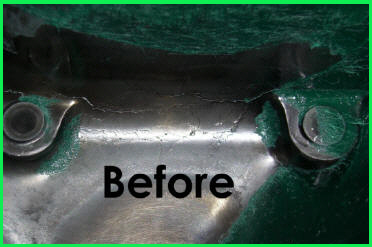
Before - many radial cracks and some existing breakout condition.

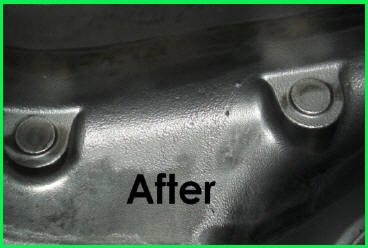
After - smaller cracks have closed with ends of cracks in compression

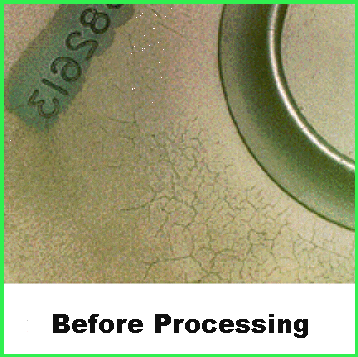
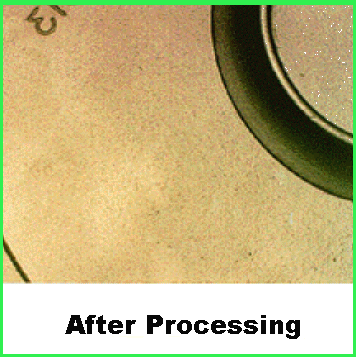
The two sets of photos above show dies before and after processing.  The photos illustrate dies that have severe heat check cracks.  In the bottom set of photos we could not completely close all cracks because some were beyond the size range of .020", however, all surfaces and both ends of these resultant cracks are encapsulated in a protective layer of compression.  The unclosed cracks have a compressive value at the ends, which prohibits the resultant existing crack from further propagation.  We cannot close existing cavitation breakout conditions that go beyond small pitting where a significant amount of metal is actually missing from the die.


The bottom sets of photos, show how completely heat checks can be closed in compression if the cracking is tended to early enough by the die caster.   MetaLL ifeÒ  also removes small surface inclusions, pits, and polish/grind marks that invite initial heat checking.


back to benefits
 

Last Modified - Wednesday September 10, 2008